A Guide to SDLC Agile Development
It's easy to think of Agile as a complete replacement for the traditional software lifecycle, but that’s not quite right. Instead of throwing the old model out, Agile makes it faster, more flexible, and far more tuned in to what customers actually want. It takes the structured phases of the SDLC and infuses them with the iterative, collaborative spirit of Agile. The result is a powerful way for teams to build great software, even when the goalposts are constantly moving.
Why SDLC and Agile Are a Powerful Combination
One of the biggest myths in software development is that you have to choose between the Software Development Life Cycle (SDLC) and Agile. The truth is, they aren't competing ideas at all. The SDLC is the essential blueprint—it outlines the fundamental stages like planning, designing, building, testing, and deploying that every project needs. It’s the "what" we need to do.
Agile, then, is the "how." It's a mindset and a collection of practices that dictate how a team moves through those SDLC phases. Think of it like this: the SDLC is the sequence for building a house (foundation, frame, plumbing, electrics). Agile is the modern building crew that works in short, focused bursts, showing the homeowner progress at every step, rather than waiting a year for the "big reveal."
Bridging Structure and Flexibility
The old-school way of doing things, the Waterfall model, treated each SDLC phase like a domino. You couldn't start design until all requirements were signed off, and you couldn't write a line of code until the entire design was finalised. This rigid, one-way street works fine if you know exactly what you need from day one, but in the real world, that's rarely the case.
The SDLC agile development approach shatters that linear process. Instead of one long, marathon-like cycle, the entire SDLC is repeated in short, iterative loops called sprints.
By blending Agile principles into the SDLC, the process shifts from a rigid, sequential conveyor belt into a dynamic, cyclical feedback loop. This lets teams deliver value in small chunks, adapt to feedback on the fly, and ensure the finished product is what users actually need.
Key Benefits of This Integrated Approach
When you marry these two concepts, you get some serious advantages over a purely traditional approach. This combination creates a development process that is both disciplined and incredibly adaptable.
Here are the main benefits you’ll see:
- Faster Time-to-Market: By shipping working features in short cycles, you can get a usable product to your customers much, much sooner.
- Increased Adaptability: Markets shift and customer priorities change. An Agile SDLC lets teams pivot without throwing the whole project into chaos.
- Improved Quality: Testing isn't an afterthought; it's a constant activity. Bugs are caught and squashed within each cycle, stopping them from snowballing into massive problems down the line.
- Enhanced Stakeholder Engagement: Clients and stakeholders are part of the team, giving regular feedback. This ongoing conversation makes sure everyone is on the same page and the team is always building the right thing.
Ultimately, the sdlc agile development framework gives you the best of both worlds: the foundational structure of the SDLC and the responsive, people-first execution of Agile.
The Limits of the Traditional SDLC Model
To really get why the agile approach to the SDLC took off, it helps to look at what came before it: the traditional model, better known as Waterfall. For years, this was the gold standard for building software. It was structured, disciplined, and left a fantastic paper trail. Its roots are in physical engineering, which makes sense—you can’t exactly change the blueprint halfway through building a bridge.
Waterfall works in a straight line. You have to finish one phase completely before you can even think about starting the next. Picture it like a set of cascading steps: first, you gather all the requirements. Then you create the entire design. Then you write all the code, followed by all the testing, and finally, you deploy the finished product.
This rigid, step-by-step process gave project managers a real sense of control. Everything was planned out from day one, budgets were set against a fixed scope, and it was simple to see if you were on track. For projects where the requirements were rock-solid and well-understood, it worked like a charm.
Where the Waterfall Model Breaks Down
But the very thing that made Waterfall so reliable—its rigidity—also became its biggest downfall in a world that moves at lightning speed. The modern market simply doesn't hang around waiting for year-long development cycles. As soon as customer needs shift or a competitor makes a move (and they always do), the Waterfall model starts to crack under the pressure.
Its main problems all come back to that one-way street approach:
- Inflexibility to Change: Once the requirements are signed off, trying to change anything is a nightmare. It's not just difficult; it's expensive. Squeezing in a new feature or tweaking an existing one often means going right back to the drawing board, leading to massive delays and blown budgets.
- Delayed Feedback: With Waterfall, the customer usually doesn't see a single line of working code until the very end. This creates a huge gamble. You might spend a year building something, only to find out it’s not what they really needed. It’s like ordering a bespoke suit but only getting to try it on twelve months later—the chances of it fitting perfectly are slim.
- High-Risk “Big Bang” Deployment: All the testing is crammed into one phase just before the finish line. This means major bugs and design flaws often pop up at the worst possible moment, leading to chaotic last-minute fixes, pushed deadlines, and a seriously stressed-out team.
The traditional SDLC model basically asks teams to bet the entire project on their initial assumptions being 100% correct from start to finish. In today’s world, that’s a bet most businesses can’t afford to make.
The Cost of Slow Delivery
This lag between starting and finishing has real-world business consequences. By the time a product built the Waterfall way is ready to launch, it might already be out of date. A competitor could have beaten you to the punch, or the problem you set out to solve might have changed completely.
Research often points to long development cycles as a key reason why projects fail. When teams are stuck building something in isolation for months on end, they run the risk of creating a perfect solution to a problem that no longer exists. This gap between the initial plan and the final delivery is where money is wasted and opportunities are lost. It became crystal clear that a faster, more adaptive, and customer-focused process was needed—and that’s exactly what paved the way for the rise of SDLC agile development.
How Agile Reshapes the Development Lifecycle
Agile doesn't just tear up the traditional Software Development Life Cycle (SDLC) rulebook; it rewrites it for a world that moves much, much faster. Instead of treating software development like a long, sequential march from A to B, the sdlc agile development approach carves the entire process into small, manageable, and repeatable cycles. We call these cycles "sprints," and each one is essentially a mini-project.
Let's use an analogy. The old-school Waterfall model is like building a car on a classic assembly line. Each station completes its task—frame, engine, bodywork, paint—before passing it to the next. You only get a finished, drivable car right at the very end, months later. If you find a flaw in the engine design, it’s a disaster to go back and fix.
Agile, on the other hand, is like building a series of high-end, custom go-karts. You build one complete, working go-kart in a couple of weeks. You show it to the customer, they take it for a spin, and give you immediate feedback. "Great! But could the next one be a bit faster and have better steering?" You take that feedback and build the next one even better.
This shift in thinking is fundamental. It means every core phase of the SDLC—planning, designing, building, and testing—happens within each and every sprint. The aim isn't a single, monolithic delivery at the end of a year, but a small, polished, and usable piece of the product every few weeks.
From Sequential Phases to Integrated Cycles
In a traditional setup, teams are often siloed. Business analysts create a hefty requirements document and throw it over the wall to the architects. Architects create designs and lob them over to the developers, who eventually pass their code to the testers. Communication is slow, formal, and often lost in translation between handoffs.
Agile demolishes these walls. It champions a deeply collaborative atmosphere where cross-functional teams work together every single day. The developer, the tester, and the product owner aren't just names on an org chart; they're partners huddled around the same table, solving problems in real-time for that sprint. This constant interaction is the secret sauce that prevents the misunderstandings and delays that plague linear projects.
The core transformation is moving from a relay race, where one runner passes the baton to the next, to a football team, where everyone is on the field, working together towards the same goal in real-time.
This iterative approach directly tackles the biggest weaknesses of the traditional model. The rigidity and snail's pace of Waterfall simply can't keep up with modern business demands, as the infographic below clearly illustrates.
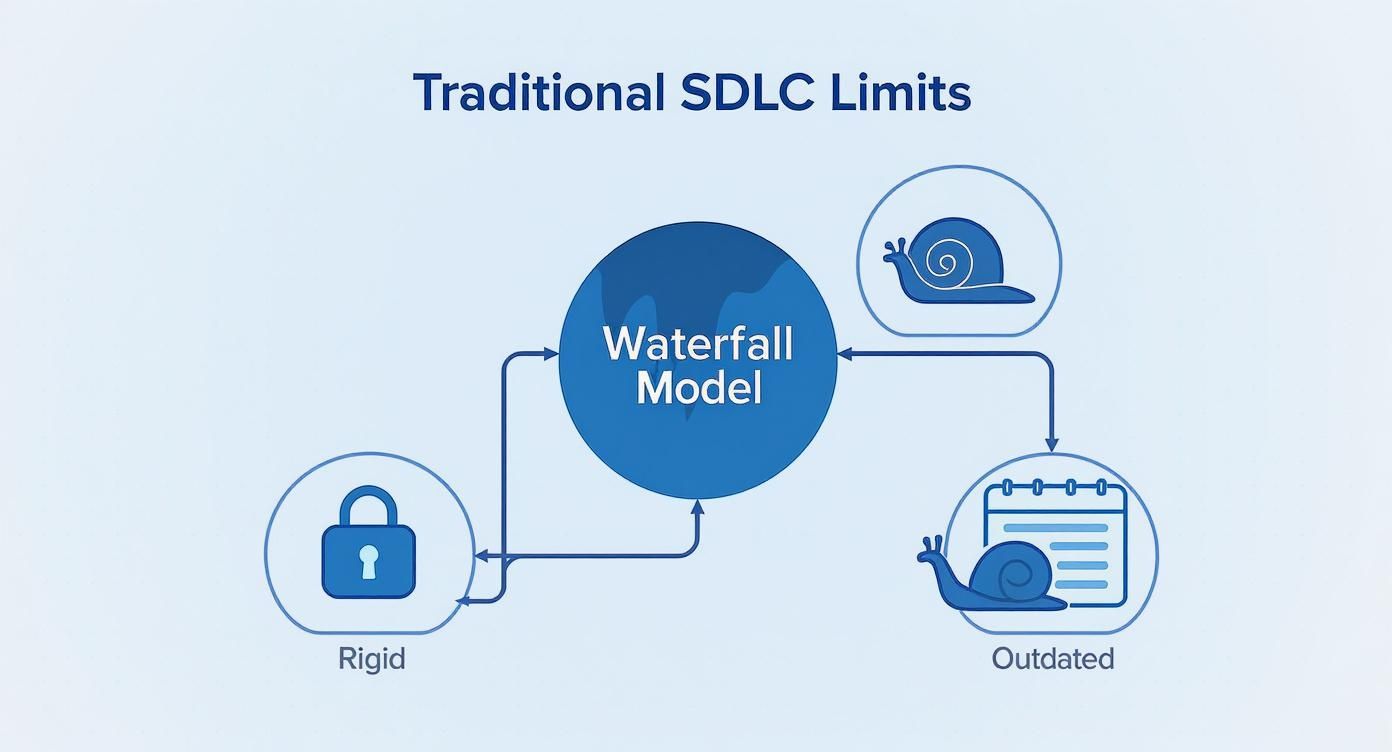
As you can see, in a market that changes by the minute, sticking to a rigid, outdated plan is a surefire way to build something nobody wants by the time it's finally finished.
Mapping Agile Practices to SDLC Phases
So, what happens to all those traditional SDLC phases like 'Requirements Gathering' and 'System Design' in an Agile world? They don't just vanish. Instead, their purpose is fulfilled through Agile’s own ceremonies, artefacts, and roles. The following table shows how these functions are mapped, maintaining discipline within a far more dynamic framework.
This table illustrates how key Agile practices and team roles fulfil the functions of the traditional SDLC phases within an iterative framework.
| Traditional SDLC Phase | Agile Equivalent (Ceremony/Artefact) | Responsible Agile Role(s) | Purpose in Agile Context |
|---|---|---|---|
| Requirements Gathering | Sprint Planning, Backlog Grooming | Product Owner, Development Team | To define and prioritise user stories for the upcoming sprint. |
| System Design | Sprint Planning, Daily Stand-ups | Development Team, Product Owner | To collaboratively design a solution for the selected user stories. |
| Implementation/Coding | The Sprint Itself | Development Team | To build and integrate the functionality described in the user stories. |
| Testing | Continuous Integration, Sprint Review | Development Team (including QA) | To test features as they are built, ensuring quality throughout the cycle. |
| Deployment | Sprint Review, Potentially Shippable Increment | Product Owner, Development Team | To release a functional increment of the product at the end of the sprint. |
| Maintenance | Ongoing Backlog Management | Product Owner, Development Team | To address bugs and technical debt as part of regular sprint work. |
This structure ensures all the crucial development functions are still covered. They're just woven into the fabric of each sprint, creating a steady, predictable rhythm of building, testing, and delivering.
The Game-Changing Benefits of an Agile SDLC
Rearranging the development lifecycle this way brings real, measurable business benefits. In the UK, the positive impact of Agile is well-established. For instance, recent industry surveys show that 93% of Agile organisations report a marked improvement in customer satisfaction, while 47% see a significant boost in team productivity. These aren't just happy accidents; they are the direct result of Agile's core principles in action. You can read more about the UK findings on agile development benefits.
The key advantages boil down to a few simple things:
- Early Risk Detection: You uncover major problems in week two, not month ten when it’s too late or expensive to fix them.
- Continuous Feedback: Stakeholders see real, working software constantly, which keeps the project perfectly aligned with business goals.
- Flexibility to Adapt: A brilliant new idea or a sudden market shift isn't a crisis. It's just an item to be prioritised for the next sprint.
By fundamentally reshaping the SDLC, Agile gives businesses a powerful competitive edge. It allows them to respond to change, reduce risk, and deliver genuine value to their customers faster and more reliably than ever before.
Choosing the Right Agile Framework for Your Team
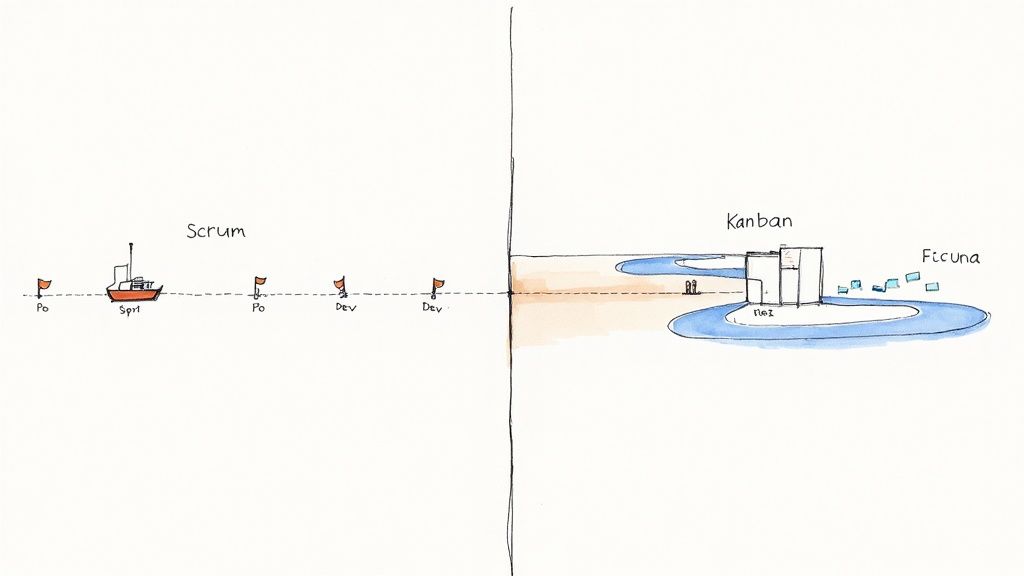
So, you’ve decided to embrace an sdlc agile development approach. That's a great first step. But "Agile" isn't a single, off-the-shelf method. It's more of an umbrella covering a family of frameworks, each with its own rhythm and rules. Picking the right one is absolutely critical; it shapes your team's entire workflow, how they talk to each other, and ultimately, whether they succeed.
Think of it like this: you've decided to get fit (that’s your Agile mindset). But how will you do it? Will you follow a structured, high-intensity interval training programme with set timings (Scrum)? Or will you focus on a steady, continuous marathon training plan that you adjust based on how you feel (Kanban)? Both get you fit, but the journey is worlds apart.
For most teams just starting out, the decision usually comes down to two of the most popular and road-tested frameworks: Scrum and Kanban.
Scrum: A Structured Sprint to the Finish Line
There’s a reason Scrum is the most widely adopted Agile framework. It offers a clear, predictable structure built on short, time-boxed cycles called sprints. These sprints, which usually last between two and four weeks, act like mini-projects, with the team delivering a usable piece of the product at the end of each one.
Scrum thrives on its defined roles (Product Owner, Scrum Master, Development Team) and its regular meetings, or ‘ceremonies’ (Sprint Planning, Daily Stand-ups, Sprint Reviews, and Retrospectives). This predictable rhythm makes it a fantastic choice for complex projects that need to be broken down into manageable, bite-sized chunks.
Imagine you're building a new mobile app. Using Scrum, you might plan your first sprint around building just the user login feature. For two weeks, that's the team's entire focus. At the end, you have a fully working, tested login screen. It creates a steady cadence of delivery and makes progress tangible.
Kanban: Visualising Your Workflow
Kanban, on the other hand, is all about flow. It’s a much more fluid system designed to help you visualise your work, spot bottlenecks, and maintain a smooth, continuous pace. Instead of fixed sprints, Kanban focuses on limiting the amount of Work in Progress (WIP) at any one time.
The heart of Kanban is the iconic Kanban board, a simple visual tool with columns like ‘To Do’, ‘In Progress’, and ‘Done’. Tasks, usually represented by cards, move across the board as work gets completed. This makes it perfect for teams dealing with a constant stream of tasks with shifting priorities, like IT support desks, maintenance teams, or content creators.
Picture a busy coffee shop. The baristas don't work in two-week ‘sprints’; they just pull the next coffee order from the queue when they have the capacity. That's Kanban in a nutshell—a 'pull' system that matches the workload to the team's actual capacity, optimising for efficiency and flow.
Scrum is like a series of planned voyages, each with a clear destination and timeline. Kanban is like managing a continuous river, ensuring the water flows smoothly without creating logjams.
These frameworks aren't just theoretical; they're the engine room of modern software development. In the UK, around 80% of software development teams now use Agile as their primary approach. Digging deeper, Scrum is the clear favourite, with 87% of UK teams adopting it. Kanban is also hugely popular, being used by 56% (and many teams use a hybrid of the two). These UK Agile adoption statistics show just how dominant these methods have become.
Scaling Agile for the Enterprise
But what happens when your business grows? How do you keep dozens of teams all aligned and working towards the same goals? This is where scaled frameworks enter the picture. Methods like the Scaled Agile Framework (SAFe) provide a comprehensive blueprint for applying Agile principles across an entire organisation.
SAFe organises multiple teams into ‘Agile Release Trains’, which work in sync to deliver much larger, integrated solutions. It adds extra layers of planning and coordination to make sure everyone is pulling in the same direction. It’s certainly more complex, but for a large business, it provides a structured way to get the benefits of an sdlc agile development process at scale.
Common Mistakes in Agile SDLC and How to Avoid Them
Making the switch to an Agile development process isn’t just about new software or fancy terminology; it’s a fundamental culture shift. I've seen many teams stumble during this transition, not because Agile is broken, but because they fall into the same predictable traps. Knowing what these pitfalls are is the first step to sidestepping them and really letting your team fly.
One of the most common issues I see is something called "cargo cult Agile." It’s where a team goes through all the motions—the daily stand-ups, sprint planning, retrospectives—but completely misses the point. They follow the rituals perfectly but lack the collaborative spirit and customer focus that actually makes Agile work. The result? You’re just building the wrong product, faster.
Mistaking Motion for Progress
It's easy to fall into the trap of obsessing over speed instead of value. Teams get hooked on metrics like velocity (how many story points they finish in a sprint) and start treating it like a score to beat. This pressure often leads to developers cutting corners, racking up technical debt, and shipping features that are "done" but don't solve a real customer problem.
Another huge hurdle is getting real buy-in from outside the development team. If your marketing, sales, and leadership teams are still stuck in a traditional, long-term planning mindset, they can accidentally torpedo your agility. They'll come in with rigid demands and fixed deadlines that just don't work with an iterative process.
The point of Agile isn't just to build things faster; it's to build the right thing faster. Success should always be measured by the value you deliver to a customer, not just how much code you churned out.
Getting this right is a delicate balance. In fact, one study found something pretty shocking: UK and US projects using Agile Manifesto practices were 268% more likely to fail than those using traditional methods. This really drives home the point that a badly managed Agile transition can be far more damaging than just sticking with what you know. You can read more about these findings on Agile project failure rates.
Practical Solutions to Common Agile Problems
Getting past these challenges takes real effort. You can't just adopt the ceremonies and call it a day; you have to tackle the cultural and operational changes that make a true Agile SDLC successful.
Here are a few actionable ways to avoid these common mistakes:
- Empower Your Teams: Don't just hand out tasks; hand over authority. Give your teams the autonomy to make real decisions about their work. When a team truly owns its process and its results, you'll see engagement and quality shoot up.
- Focus on Value-Driven Metrics: Stop measuring raw output (like lines of code or story points) and start measuring outcomes (like customer satisfaction, user engagement, or conversion rates). This move directly connects your team's day-to-day work with what the business actually needs to achieve.
- Invest in a Security-First Mindset: The temptation to move fast can mean security gets pushed to the side. It's crucial to build security checks into your sprints right from the start. For smaller outfits, just getting a handle on the essentials of cybersecurity for small business can prevent incredibly expensive mistakes later on.
- Educate the Entire Organisation: Run workshops and hold regular catch-ups with non-technical departments. You need to help them understand the "why" behind Agile—the short cycles, the flexible plans, and why continuous feedback is so valuable. When everyone is speaking the same language, collaboration gets a whole lot easier.
Your Action Plan for Adopting an Agile SDLC
Switching to an sdlc agile development process feels like a massive undertaking, but it doesn't have to be. The trick is to break the big shift down into smaller, more manageable steps. This action plan is your roadmap, guiding you from getting the initial nod of approval all the way to a full-scale rollout.
The journey doesn't start with software or scrum boards; it starts with people. Any attempt to go Agile is set up to fail without real backing from the top. You absolutely have to get key decision-makers on board by showing them the business value—we’re talking faster delivery, better quality products, and the ability to react to market changes on a dime.
Once leadership gives the green light, you can really get moving.
Laying the Groundwork for Success
Before you start re-organising departments, think small. Your first goal is to prove the concept works, learn from the inevitable early mistakes, and build some positive momentum. A carefully selected pilot project is the perfect way to test the waters in a lower-risk setting.
Here's how to get started methodically:
- Secure Leadership Buy-In: Don't just talk about process. Build a solid business case focused on outcomes like slashing time-to-market and boosting customer satisfaction.
- Select a Pilot Project: Pick something that matters, but won't sink the ship if it goes wrong. It needs to be complex enough for a real test but not so huge it becomes a monster to manage.
- Choose Your Framework: Look at the project's needs. Does the structured, time-boxed approach of Scrum make sense? Or is Kanban's continuous flow a better fit? It's fine to keep it simple at first.
- Provide Comprehensive Training: This is non-negotiable. Invest in proper training for everyone on the pilot team. They need to understand the Agile mindset, the nuts and bolts of the framework (like Scrum ceremonies), and their specific roles.
With these foundations sorted, you're ready to pick your team and get the right tools in place.
Executing Your First Sprint
The right tech stack can make or break your new workflow. Choose project management tools like Jira or Trello to help everyone see the work and track its progress. And if you have a remote team, good communication tools are an absolute must. Many smaller businesses find that starting with a solid foundation of cloud solutions for small business gives them the flexibility they need right from the get-go.
Next up: you need to define what 'done' and 'successful' actually mean.
Don't get lost tracking vanity metrics like story points or velocity. Instead, focus on what truly matters: customer value. Measure things like user engagement or how many people are actually using a new feature. Real success is about giving the customer what they need, not just ticking off tasks.
Now, you’re ready for launch. Run that first sprint, and be disciplined about sticking to the ceremonies you've trained for. The sprint retrospective is probably the most important part of this whole phase. It’s your first real opportunity to get honest feedback, so listen. What worked? What was a total pain? Use those insights to tweak your process for the next round.
Scaling Your Agile Adoption
After you’ve got a few successful sprints under your belt, you’ll have hard results and some valuable lessons. This is your success story—use it to build confidence across the rest of the company.
From here, plan a phased rollout. Introduce your sdlc agile development process to other teams one by one. This gradual approach means you can provide proper support, fine-tune your methods as you go, and make sure this new way of working really sticks and becomes part of your company's DNA.
Frequently Asked Questions
Switching to an Agile SDLC often brings up a few common questions. Let's tackle some of the ones we hear most often from teams navigating this change.
How Does Agile Handle Long-Term Project Planning?
This is a big one, especially for leaders accustomed to traditional, detailed roadmaps. The short answer is that Agile doesn't ditch long-term planning; it just makes it smarter and more flexible.
Instead of a rigid, five-year plan set in stone, Agile relies on a product roadmap. Think of it as a high-level guide that outlines the major goals and themes for the product. It provides direction without getting bogged down in details that will inevitably change. This roadmap is reviewed and updated regularly, allowing the team to prioritise what’s next based on real customer feedback and market shifts, not on assumptions made a year ago.
What Is the Role of a Project Manager in an Agile SDLC?
In a textbook Scrum setup, the classic Project Manager role doesn't exist. Instead, its responsibilities are distributed among three distinct roles:
- The Product Owner: They own the 'what'. They represent the customer, manage the product backlog, and decide which features will deliver the most value.
- The Scrum Master: They are the team's coach and facilitator. Their job is to remove roadblocks and make sure the team can work effectively within the Agile framework.
- The Development Team: This self-organising group owns the 'how'. They decide how to tackle the work within each sprint to meet the goals set by the Product Owner.
So, where does a Project Manager fit in? Often, they transition into a Scrum Master or Product Owner role. In larger organisations, they might become programme managers, helping to coordinate work across several Agile teams.
The real change is a move away from a 'command and control' style of management. It's about becoming a 'servant leader' who empowers the team to do their best work. This mindset shift is crucial for Agile to truly take root.
Can Agile Work for Non-Software Projects?
Definitely. While Agile's roots are firmly in software development, its core principles are universal. Iterative work, constant feedback, and adaptability are powerful tools for almost any complex project.
We've seen marketing teams use Agile to launch campaigns, HR departments use it to streamline recruitment, and even some construction firms adopt its methods. Any project that involves a degree of uncertainty and could benefit from adapting to new information along the way is a great candidate for an Agile approach.
Want to see more examples? We cover a wide range of business applications over on the Lizzard Solutions company blog.
Ready to build a development process that actually works for your business but don't know where to begin? Lizzard Solutions provides expert IT and AI consultancy designed to help startups and small businesses modernise and grow. Let's get your technology and business goals perfectly aligned.